


Hard Drive Surgery Cleanroom: Purpose & Importance in Data Recovery
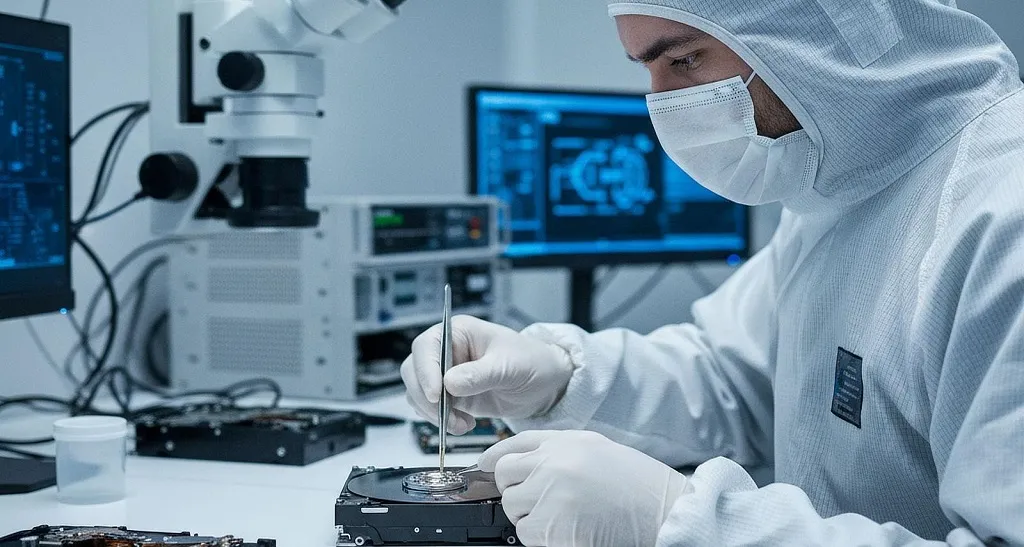
Cleanroom for Hard Drive Surgery
Recovering data from hard drives that have suffered hardware failures sometimes requires specialized procedures to be performed inside the hard drive enclosure. These procedures, known as hard drive surgery, must be carried out in a strictly controlled environment, as even the smallest airborne contaminant can damage the sensitive disk surface and reduce the chances of successful data recovery.
For this reason, using a cleanroom for hard drive surgery is considered one of the most important requirements for professional data recovery centers. A cleanroom is a controlled environment in which airborne particles, environmental contaminants, temperature, and humidity are carefully monitored and regulated.
In this article, we will explore the concept of cleanrooms, Class 100 standards, their applications in hard drive surgery, the required equipment, and the key characteristics of a standard cleanroom environment.
A Brief Explanation of Cleanrooms
A cleanroom is a controlled environment in which the concentration of airborne particles and other contaminants is reduced through the use of specialized equipment.
In ordinary environments, particles such as dust, clothing fibers, hair, and extremely fine contaminants are constantly present in the air. Although many of these particles are invisible to the naked eye, they can cause problems for sensitive electronic and mechanical equipment.
By using filtration systems, controlled airflow, and monitoring equipment, a cleanroom creates conditions in which sensitive operations can be performed in an environment with extremely low contamination levels. Cleanrooms are used in various industries, including medical equipment manufacturing, pharmaceutical production, electronics, semiconductor manufacturing, and specialized data recovery centers.
For more information about the structure, equipment, and standards of this environment, you can read the article What Is a Clean Room and What Are Its Applications?
What Is the Purpose of a Cleanroom for Hard Drive Surgery?
The purpose of a cleanroom in hard drive surgery is to provide a clean and controlled environment for opening the hard drive enclosure and performing the necessary procedures on its internal components.
Inside a hard drive, magnetic platters are manufactured with extremely high precision, and the read/write heads move at a very small distance above their surfaces. The entry of dust particles or other contaminants into the hard drive enclosure can interfere with the operation of these components.
For this reason, whenever opening the hard drive enclosure becomes necessary, the procedure must be performed in an environment where airborne particle levels are controlled.
The most important applications of cleanrooms in data recovery centers include:
- Providing a suitable environment for opening hard drive enclosures.
- Reducing the risk of dust entering the internal space of the hard drive.
- Creating suitable conditions for inspecting internal components.
- Providing a controlled environment for performing specialized procedures on hard drives.
- Reducing the risk of contamination during component reassembly.
- Helping maintain suitable conditions throughout the data recovery process.
Therefore, a cleanroom is not simply an ordinary clean room; it is an essential part of the infrastructure of professional data recovery centers.
What Is Hard Drive Surgery and Why Does It Require a Cleanroom?
Hard drive surgery refers to a series of procedures performed to inspect or intervene in the internal components of a hard drive. These procedures are generally considered necessary when a hard drive has suffered a hardware failure and inspecting or repairing it is not possible without opening its enclosure.
For example, in certain mechanical failures, it may be necessary to inspect the condition of the read/write heads, internal platters, or other hard drive components.
An important point to note is that not every hard drive failure requires surgery. Many hard drive problems can be assessed by checking connections, the electronic circuit board, or using software-based methods. Opening the hard drive enclosure is only performed when technically necessary.
The need for a cleanroom is directly related to the sensitivity of the hard drive’s internal components. The surfaces of magnetic platters and the head assembly are extremely sensitive to contamination, and the entry of foreign particles can cause further damage.
For this reason, performing hard drive surgery in an ordinary environment without contamination-control equipment is not recommended.
What Is a Class 100 Cleanroom?
One of the commonly used terms in the field of cleanrooms is Class 100 cleanroom.
Under the older FED-STD-209E standard, a Class 100 environment was defined as one in which the number of airborne particles measuring 0.5 microns or larger did not exceed 100 particles per cubic foot of air.
This classification has now been superseded by newer standards, such as ISO 14644. Class 100 is generally considered approximately equivalent to ISO Class 5.
Under ISO Class 5, the maximum allowable number of particles measuring 0.5 microns or larger is 3,520 particles per cubic meter of air.
It is important to understand that no cleanroom is completely free of particles. The purpose of cleanroom design is to reduce and control the number of airborne particles within a specified standard range.
For specialized data recovery centers, the appropriate cleanroom classification must be selected based on the type of operation, environmental design, and technical requirements.
Why Is Opening a Hard Drive in an Ordinary Environment Dangerous?
The internal space of a hard drive is designed to operate under controlled conditions. The introduction of contaminants into this space can interfere with the performance of sensitive components.
One of the main reasons cleanrooms are important is the extremely small distance between the read/write head and the platter surface. This distance is so small that the presence of foreign particles can cause unintended contact, interfere with head movement, or damage the disk surface.
Some of the risks associated with opening a hard drive in an unsuitable environment include:
1. Dust Entering the Hard Drive Enclosure
Dust particles may settle on the platter surfaces or internal components and interfere with the hard drive’s operation.
2. Increased Risk of Platter Surface Damage
The presence of foreign particles inside the hard drive can increase the likelihood of scratches or damage to the magnetic surface.
3. Disruption of Read/Write Head Operation
Contamination can affect the precise movement of the read/write heads and increase the likelihood of mechanical problems.
4. Reduced Chances of Successful Data Recovery
In hard drives that are already damaged, additional contamination or physical damage may make the data recovery process more difficult.
For this reason, using a specialized cleanroom for hard drive surgery is extremely important when performing procedures inside a hard drive enclosure.
Equipment Required in a Specialized Cleanroom for Hard Drive Surgery
A standard cleanroom consists of a range of filtration, environmental control, and contamination-monitoring equipment. Each piece of equipment has a specific role in maintaining the required environmental conditions.
1. HEPA Filter
A HEPA filter is one of the most important components of a cleanroom air purification system. These filters are designed to capture extremely fine airborne particles and play a significant role in reducing contamination in the air entering the environment.
When designing a cleanroom, the selection of the filter type, filtration efficiency, installation location, and sealing method is extremely important.
2. Laminar Airflow System
A laminar airflow system creates a uniform and controlled airflow that helps reduce particle accumulation within the working area.
This system can be designed to operate either horizontally or vertically. The choice of airflow direction depends on the room structure, the location where operations are performed, and the ventilation system design.
3. Particle Counter
A particle counter is used to measure the number of airborne particles in an environment.
Using this device, it is possible to assess the cleanliness of the environment and determine how well it complies with the required cleanroom classification.
4. Temperature and Humidity Control Equipment
Temperature and humidity are important factors in specialized environments. Inappropriate changes in these conditions can affect equipment performance and working conditions.
For this reason, a cleanroom must be equipped with temperature and humidity monitoring and control systems.
5. Electrostatic Discharge (ESD) Protection Equipment
Static electricity can pose a serious risk to sensitive electronic components. Therefore, ESD protection equipment is used in specialized repair and data recovery environments.
Such equipment includes antistatic flooring, grounding wrist straps, and suitable work surfaces.
6. Specialized Cleanroom Clothing and Protective Garments
Employees’ clothing is one of the potential sources of particle contamination entering the environment. For this reason, anyone entering a cleanroom must wear appropriate protective clothing.
This clothing generally includes specialized cleanroom garments, caps, masks, gloves, and dedicated footwear or shoe covers.
Characteristics of a Standard Cleanroom for Hard Drive Surgery
Simply installing an air filter is not enough to make an environment genuinely suitable for hard drive surgery. The cleanroom must be designed and constructed according to technical requirements and the operating conditions of the facility.
The most important characteristics of a specialized cleanroom include:
-
Proper Air Filtration: Using standard filters and an air purification system appropriate for the required cleanroom classification.
-
Airborne Particle Control: The ability to measure and monitor the level of airborne contamination.
-
Controlled Airflow: Preventing particle accumulation in the area where operations are performed.
-
Temperature and Humidity Control: Maintaining environmental conditions within specified limits.
-
Positive Air Pressure: In conventional cleanroom designs, the air pressure inside the room is maintained at a higher level than in adjacent areas to reduce the entry of contaminated air.
-
Cleanable Surfaces: Using suitable, low-particle-emission materials for walls, floors, and workbenches.
-
Controlled Entry and Exit: Designing personnel and equipment access routes to minimize the transfer of contamination.
-
Periodic Maintenance and Testing: Inspecting the performance of filters, ventilation systems, and the overall cleanliness of the environment.
In addition, the necessary tests should be performed before the cleanroom becomes operational to verify its cleanliness classification, and the results should be properly documented.
Difference Between a Cleanroom for Hard Drive Surgery and a Cleanroom for Mobile Phone Repair
Cleanrooms may be used in various repair and electronic service industries; however, the requirements for each type of operation are not necessarily the same.
For example, a cleanroom for mobile phone repair is primarily designed to provide a suitable environment for working on sensitive components, displays, and electronic equipment.
In contrast, a cleanroom for hard drive surgery must provide the conditions required to open hard drive enclosures and work on their highly sensitive internal components.
|
Feature |
Cleanroom for Hard Drive Surgery |
Cleanroom for Mobile Phone Repair |
|---|---|---|
|
Primary Application |
Procedures performed inside the hard drive enclosure |
Repairing mobile phone components and equipment |
|
Sensitivity to Contamination |
Extremely high within the internal hard drive environment |
Depends on the type of component and operation |
|
Particle Control |
Based on the required cleanliness classification |
Based on the type of operation |
|
Specialized Equipment |
Environmental filtration and monitoring equipment |
Repair equipment and contamination-control systems |
|
Main Objective |
Reducing the risk of contamination of internal hard drive components |
Providing a suitable environment for repair operations |
Therefore, an environment cannot be considered suitable for hard drive surgery simply because it is called a cleanroom or has an air filtration system. Its design and technical specifications must be compatible with the intended operation.
Stages of Hard Drive Surgery in a Cleanroom
At specialized centers, the hard drive surgery process generally begins with an initial inspection of the device and identification of the type of failure.
In general, this process involves the following stages:
1. Initial Hard Drive Inspection
First, the external condition, signs of failure, and operating status of the hard drive are examined to determine whether opening its enclosure is necessary.
2. Environmental Preparation
Before the procedure begins, the cleanroom conditions and required equipment are inspected to ensure that the environment is in an appropriate state in terms of cleanliness and system performance.
3. Performing Specialized Procedures
If necessary, the inspection and intervention involving the hard drive’s internal components are performed by a specialist using appropriate equipment.
4. Reassessment and Data Recovery
After the necessary procedures have been completed, the condition of the hard drive is reassessed and, if possible, the process of extracting and transferring the data is carried out.
5. Data Delivery
Finally, the recoverable data is transferred to an appropriate storage device, in accordance with the agreement with the customer.
It should be noted that the outcome of data recovery depends on the type of failure, the extent of the damage, and the condition of the hard drive’s internal components. No specialized method can guarantee 100% data recovery under all circumstances.
When Do You Need a Cleanroom for Hard Drive Repair?
Not all hard drive failures require the use of a cleanroom. In many cases, the problem can be investigated through software-based diagnostics or repairs to electronic components.
However, when opening the hard drive enclosure and inspecting its internal components becomes necessary, using a cleanroom is essential.
Some signs that may indicate the need for specialized inspection include:
- Unusual noises coming from the hard drive.
- The hard drive failing to power on, accompanied by signs of hardware failure.
- The hard drive not being detected by the computer system.
- Malfunctioning after the hard drive has been dropped or physically impacted.
- Mechanical problems affecting the device’s operation.
- The need for a specialist to inspect the hard drive’s internal components.
If your hard drive is making unusual noises or there is a possibility of mechanical failure, it is best to turn the device off and avoid repeatedly powering it on and off. In addition, opening a hard drive at home or in an ordinary environment can increase the risk of further damage.
A Guide to Purchasing and Setting Up a Cleanroom for Hard Drives
Setting up a cleanroom for hard drive surgery requires a careful assessment of the technical conditions and the type of operations performed at the facility. Selecting equipment without considering the overall environmental design may prevent the room from achieving the required cleanliness classification.
Before purchasing or commissioning the construction of a cleanroom, it is advisable to consider the following factors:
1. Determining the Required Cleanliness Classification
First, it must be determined what type of operation the environment is intended for and what level of particle control is required.
2. Assessing the Required Dimensions and Space
The room dimensions must be determined based on the number of employees, equipment, workbenches, and movement pathways.
3. Selecting the Filtration System
The type of filters, ventilation system capacity, air change rate, and airflow distribution method must be selected based on technical calculations.
4. Selecting Suitable Construction Materials
Walls, floors, ceilings, and interior surfaces must be made of materials that are easy to clean and generate the lowest possible number of particles.
5. Designing the Environmental Control System
The temperature, humidity, and pressure control systems must be selected according to the cleanroom’s design specifications.
6. Performance Testing and Verification
After installation and commissioning, the performance of the systems and the cleanliness classification of the environment must be evaluated and documented through recognized testing procedures.
7. Periodic Maintenance
Filter replacement, equipment performance inspections, and periodic testing are essential to maintaining standard operating conditions.
When purchasing a cleanroom for hard drive surgery, rather than focusing solely on equipment prices, it is advisable to pay attention to engineering design, construction quality, after-sales services, and the availability of performance verification testing.
How to Choose a Data Recovery Center Equipped with a Cleanroom for Hard Drive Surgery
If you intend to submit your damaged hard drive to a specialized data recovery center, you should not rely solely on advertisements or claims that the facility has a cleanroom.
A professional center should be able to provide clear explanations regarding its working environment, the equipment it uses, and the procedures it follows.
When choosing an appropriate center, consider the following factors:
- The availability of a dedicated space for sensitive hard drive operations.
- The use of an appropriate air filtration system.
- Monitoring and control of environmental conditions.
- The use of specialized data recovery equipment.
- The presence of skilled and experienced technicians.
- Providing clear explanations about the hard drive’s condition and the likelihood of successful data recovery.
- Providing a report and cost estimate before carrying out any procedures.
It is also advisable to choose a center that examines the hard drive’s condition before taking any action and explains whether surgery is necessary and what the likelihood of successful data recovery is.
Frequently Asked Questions About Cleanrooms for Hard Drive Surgery
1. What Is a Cleanroom for Hard Drive Surgery?
A cleanroom for hard drive surgery is a controlled environment in which airborne particles and contaminants are reduced to allow the hard drive enclosure to be opened and specialized procedures to be performed on its internal components with a lower level of risk.
2. Why Must Hard Drive Surgery Be Performed in a Cleanroom?
Because the internal components of a hard drive, particularly its magnetic platters and head assembly, are sensitive to dust particles. Contamination entering the hard drive enclosure can cause further damage and reduce the chances of successful data recovery.
3. What Is a Class 100 Cleanroom?
Class 100 is an older classification system for cleanrooms under which the number of airborne particles measuring 0.5 microns or larger must not exceed 100 particles per cubic foot of air. This classification is approximately equivalent to ISO Class 5.
4. Does Every Hard Drive Failure Require Surgery?
No. Many hard drive problems can be investigated through software-based diagnostics or repairs to electronic components. Surgery is considered necessary when opening the hard drive enclosure is required to inspect or intervene in its internal components.
5. What Is the Most Important Equipment in a Hard Drive Cleanroom?
HEPA filters, controlled airflow systems, particle counters, temperature and humidity control equipment, electrostatic discharge protection equipment, and specialized protective clothing for employees are among the most important pieces of equipment in this environment.
6. Is a Cleanroom Designed for Mobile Phone Repair Suitable for Hard Drive Surgery?
Not necessarily. The requirements for mobile phone repair and opening a hard drive enclosure are not the same. The environment used for hard drive surgery must be designed and certified according to the sensitivity of the hard drive’s internal components and the required cleanliness classification.
7. Can You Open a Hard Drive at Home?
No, this is not recommended. Home or ordinary workplace environments do not have controlled airborne particle levels, and opening a hard drive enclosure can allow contaminants to enter and increase the extent of the damage.
8. What Should You Consider When Purchasing a Cleanroom for Hard Drive Surgery?
The cleanliness classification, filtration quality, airflow design, temperature and humidity control, particle-monitoring equipment, construction quality, and the availability of performance verification testing are among the most important factors.
Conclusion
A cleanroom for hard drive surgery is one of the essential infrastructure components of professional data recovery centers. The sensitivity of a hard drive’s internal components to airborne particles makes a controlled environment necessary for opening the enclosure and performing specialized procedures.
The use of HEPA filters, appropriate airflow systems, particle-monitoring equipment, temperature and humidity control, and compliance with proper entry and exit procedures are among the most important factors in designing a standard cleanroom.
If you intend to establish such an environment, it is advisable to base the design and equipment selection on the type of operation, the required cleanliness classification, and recognized standards. In addition, if your hard drive has suffered a hardware failure, you should submit it to a specialized data recovery center before taking any action to prevent further damage.