

Is a Cleanroom? A Comprehensive Guide to Its Definition, Standards, Components, and Design”
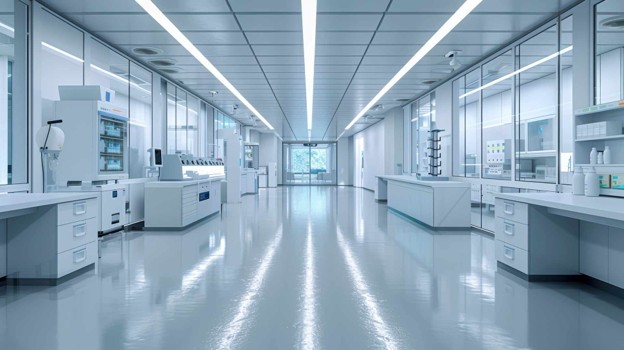
A cleanroom, or clean room, is a highly engineered and strictly controlled environment in which the concentration of airborne particles, temperature, humidity, air pressure, and other environmental parameters are managed with a very high degree of precision to prevent contamination from entering sensitive processes. These spaces play a vital role in industries such as pharmaceuticals, medical devices, semiconductors and electronics, biotechnology, aerospace, and nanotechnology—industries in which a single invisible microscopic particle can ruin the results of months of research or render a million-dollar product worthless.
In this article, we will take a comprehensive look at the definition of a cleanroom, its history and development, international ISO standards, its main components and specialized HVAC system, types of airflow, personnel entry regulations, the design and construction process, costs, and industrial applications.
What Is a Cleanroom?
A cleanroom is a controlled space in which the concentration of airborne particles, chemical contaminants (such as vapors and gases), microbial contamination, and environmental parameters including temperature, humidity, and air pressure are precisely controlled. Contrary to common perception, a cleanroom is not simply “a very clean room”; rather, it is an engineered ecosystem designed to limit particle concentrations to exceptionally low levels and continuously monitor them.
Based on the required level of cleanliness and the maximum allowable number of particles, cleanrooms are divided into different classifications. These classifications are defined by various standards, such as ISO 14644 and GMP. Today, cleanrooms are used across a wide range of manufacturing industries, including pharmaceuticals, cell therapy, electronics, nuclear technology, medical devices, and even certain automotive production lines.
The History of Cleanrooms
The concept of the cleanroom first emerged in the 1960s in the U.S. military and aerospace industries. The initial objective was to reduce particle contamination during the assembly of sensitive electronic components used in aircraft and military equipment. Over time, advances in filtration and ventilation technology led to the rapid expansion of cleanroom applications into pharmaceuticals, semiconductors, medical devices, and research laboratories. Today, cleanrooms are an integral part of the manufacturing infrastructure for products that require a high degree of precision and contamination control.
Why Are Cleanrooms Important?
The importance of cleanrooms is undeniable in industries where even a microscopic particle can have serious consequences:
- In the pharmaceutical industry, a single bacterium can contaminate an entire batch of injectable medication and put patients’ health at risk.
- In the semiconductor industry, a single dust particle on a silicon wafer can cause a short circuit in microscopic circuitry and render an entire processor unusable.
- In medical devices, microbial contamination on a syringe, implant, or contact lens can directly threaten a patient’s health.
The advancement of many modern technologies, from pharmaceuticals to electronic chips, would simply not have been possible without cleanrooms.

Classification of Contaminants in Cleanrooms
Cleanroom designers ensure effective cleanroom performance through the precise and scientific management of contamination sources. Contaminants are generally divided into three main categories:
| Type of Contaminant | Examples | Importance of Control |
|---|---|---|
| Solid particles | Dust, metals, fibers | Even small particles can compromise product quality or process integrity |
| Chemical contaminants | Vapors, gases | They may chemically react with the product, contaminate it, or damage sensitive equipment |
| Biological contaminants | Bacteria, fungi, viruses | They pose a serious risk to pharmaceutical products and medical devices |
These contaminants can enter the environment from various sources: outdoor air, equipment inside the cleanroom, raw materials, and, most importantly, people themselves. A person at rest can generate approximately 100,000 particles larger than 0.3 microns per minute. For this reason, controlling personnel behavior and clothing is an integral part of cleanroom design.
A multilayered strategy is used to control these contaminants: high-efficiency air filtration and pass-through chambers to reduce the entry of contaminants from outside; the use of specialized materials and garments to prevent contamination generation inside the cleanroom; and engineered airflow design to rapidly remove contaminants generated within the environment.
Cleanroom Standards and Classification (ISO 14644)
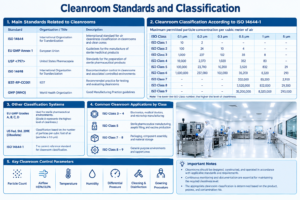
The most widely recognized and commonly used international reference for cleanroom classification is ISO 14644-1, which replaced the former U.S. Federal Standard (FS209E). This standard classifies cleanrooms according to the maximum allowable concentration of particles of specified sizes per cubic meter of air. It defines classes ranging from ISO 1 (the cleanest achievable level) to ISO 9 (a level close to typical indoor air in an office environment). The lower the classification number, the cleaner the cleanroom.
To better understand the scale of this standard:
- In ISO Class 1, only about 10 particles per cubic meter are permitted.
- An ISO Class 3 cleanroom should contain no more than 1,000 particles measuring 0.1 microns and only 35 particles measuring 0.5 microns per cubic meter of air.
- In ISO Class 9, the number can reach millions of particles.
For comparison, typical urban air can contain more than 35 million particles measuring 0.5 microns per cubic meter. Compliance with ISO standards is essential for ensuring quality, process reproducibility, and regulatory approval. In addition to ISO 14644, the pharmaceutical industry also follows GMP (Good Manufacturing Practice), which, beyond particle control, establishes requirements for hygiene, material flow, and personnel behavior.
Each cleanroom classification has specific requirements for personnel entry and exit, including the use of airlocks before entering the cleanroom. These airlocks are equipped with interlocking systems and, depending on the design, may be configured as Bubble, Cascade, or Sink arrangements based on pressure differentials. Personnel gowning requirements also vary according to the cleanroom classification.
Key Components of an Effective Cleanroom
Building an effective cleanroom requires the precise coordination of several engineering components, each of which plays a vital role in maintaining environmental cleanliness.
| Feature | Description | Importance |
|---|---|---|
| Particle count and size | Precise control of airborne particles using HEPA/ULPA filters | Preventing contamination of sensitive products |
| Temperature and humidity | Precise control of temperature and relative humidity | Maintaining stable conditions for sensitive processes |
| Air pressure | Creating a stepped positive or negative pressure regime | Preventing contaminants from entering more sensitive areas |
| Airflow | Laminar or turbulent airflow design and appropriate ventilation | Reducing particle accumulation in critical areas |
| Electrostatic control | Use of anti-static materials and equipment | Maintaining the safety and performance of sensitive electronic equipment |
| Vibration control | Reducing environmental vibrations through structural and foundation design | Maintaining equipment precision in sensitive processes |
Specialized Heating, Ventilation, and Air Conditioning (HVAC) System
The heart of every cleanroom is its specialized HVAC system, which performs functions far beyond simply controlling the temperature of a conventional building. It supplies large volumes of ultra-clean air, precisely controls temperature (typically with a tolerance of less than 1°C), manages relative humidity, and, most importantly, establishes a stepped positive-pressure regime. This positive pressure ensures that air consistently flows from cleaner areas toward areas with lower levels of cleanliness, preventing contamination from entering sensitive spaces.
In summary, the air handling unit (AHU) operates as follows: outdoor air first enters the purification system, then passes through multiple stages of pre-filters and, ultimately, HEPA or ULPA filters, where airborne contaminants are removed. The purified air is then supplied to the cleanroom at a specified pressure through ducts, filter boxes, and dedicated air diffusers. Meanwhile, air inside the room is either exhausted through return air outlets or recirculated through the filtration system.
HEPA and ULPA Filters
HEPA (High-Efficiency Particulate Air) filters, which according to the applicable standard must be capable of capturing at least 99.97% of particles measuring 0.3 micrometers, are used in most cleanrooms. For more sensitive environments, such as the semiconductor industry, ULPA (Ultra-Low Penetration Air) filters may be used, capable of capturing 99.999% of particles measuring 0.12 micrometers. Continuous air filtration helps maintain the dynamic cleanliness of the cleanroom environment.
Physical Structure: Walls, Floors, and Ceilings
Unlike conventional buildings, cleanroom construction requires materials that are completely smooth, seamless, non-porous, abrasion-resistant, and resistant to chemicals. These characteristics prevent particle accumulation and microbial growth while making cleaning and disinfection easier. Materials such as metal- or PVC-faced sandwich panels, vinyl sheets, stainless steel, and seamless epoxy flooring are among the most common options. Antistatic flooring is also required where necessary to prevent the accumulation of electrostatic charges. Corners and joints are typically designed with curved profiles to eliminate areas where contaminants can accumulate.
Doors, Windows, and Airlocks
Personnel and equipment enter the cleanroom through intermediate spaces known as airlocks. These rooms are equipped with interlocked doors, which cannot be opened simultaneously, and serve as buffers for pressure and contamination control. Windows are generally double-glazed and flush-mounted with the wall to minimize disruption to airflow.
In higher-class cleanrooms, personnel may pass through an air shower before final entry. An air shower directs high-velocity filtered air (typically at speeds exceeding 20 meters per second) over the person’s garments, dislodging particles from the clothing and directing them toward the filtration system.
Specialized Personnel Clothing and Gowning
Because humans are the largest source of contamination in a cleanroom, entry requires the use of specialized, low-lint garments. The type of clothing required varies according to the cleanroom classification. In lower classifications, a lab coat, head covering, and boots may be sufficient; however, entry into higher-class cleanrooms may require specialized full-body garments with full-length zippers, boots, gloves, and appropriate respiratory protection. Cleanroom apparel typically includes boots or shoe covers, aprons, beard covers, caps, coveralls (bunny suits), face masks, gowns, gloves, and sleeves. The garments themselves must also be designed to minimize particle and fiber release, as such personnel-generated contamination can compromise product quality in pharmaceutical and semiconductor industries or, in healthcare environments, contribute to cross-contamination between staff and patients.

Types of Airflow in Cleanrooms
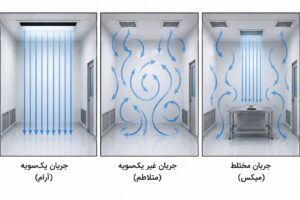
The way air moves within a cleanroom has a direct impact on its ability to remove contaminants and is one of the factors that determines the cleanroom classification. There are three main airflow patterns:
1. Laminar or Unidirectional Flow: This type of airflow is essential for high-class cleanrooms (typically ISO 5 and cleaner). Filtered air moves as a uniform front, typically at a velocity of 0.3 to 0.45 meters per second, from the entire ceiling surface toward the floor. This airflow acts like a piston, immediately carrying generated contaminants toward exhaust outlets at floor level and preventing their dispersion or accumulation.
2. Turbulent or Non-Unidirectional Flow: This type is used for lower-class cleanrooms (typically ISO 6 to ISO 8). Filtered air enters the room through ceiling diffusers in a swirling and irregular pattern, mixes with the existing room air, and maintains the required cleanliness level by diluting contaminant concentrations and directing them toward the exhaust outlets. This approach is more economical than unidirectional flow in terms of both construction costs and energy consumption.
3. Mixed Airflow: This approach combines the two patterns above and is used in different areas of the same cleanroom. For example, unidirectional flow may be used directly above critical work surfaces, while turbulent airflow is used throughout the remaining areas. Due to its high efficiency and relatively low cost, this approach is widely used.
- Cleanroom Design and Construction ProcessDesigning and constructing a cleanroom is a specialized, multidisciplinary process that requires extensive knowledge of mechanical engineering, electrical engineering, control systems, architecture, and chemistry. The main stages of this process typically include:
- Needs Assessment and Cleanroom Classification: Assessing the type and sensitivity of the production process and precisely defining the User Requirements Specification (URS) to select the appropriate cleanroom classification (e.g., ISO 5 or ISO 7).
- Conceptual Design and Layout Planning: Designing material, personnel, and airflow pathways to minimize the risk of cross-contamination.
- Basic and Detailed Engineering Design: Selecting antimicrobial and corrosion-resistant materials, designing the HVAC system, and determining airflow paths.
- Mechanical and Electrical Installation: Installing ventilation, filtration, lighting, and intelligent control systems.
- Panel Installation and Construction Completion: Installing walls, floors, and ceilings and completing the final insulation and sealing work.
- Testing and Validation: Upon completion of the project, the cleanroom is tested for airflow, pressure, temperature, and particle counts to verify compliance with the specified standard.
Even the smallest error at any of these stages can result in failure to achieve the required classification and potentially compromise the entire investment. For this reason, working with specialized cleanroom design and construction teams that have a thorough understanding of the stringent requirements of ISO standards is highly important.
Cleanroom Personnel Regulations and Behavior
A set of behavioral regulations must be followed to minimize human-generated contamination, including:
- Hands, nails, and face must always be kept clean.
- Combing or adjusting hair inside the cleanroom is prohibited.
- Wearing jewelry on the hands or chest is not permitted.
- Bringing foreign objects such as keys, cigarettes, coins, pencils, tissues, combs, and mobile phones into the cleanroom is prohibited.
- Eating and drinking are prohibited inside the cleanroom.
- Scratching, rubbing the hands together, or playing with the hair should be avoided.
- Wearing ordinary outdoor clothing inside the cleanroom is not permitted.
- Work should be performed only on clean and sanitized surfaces.
- Movement inside the cleanroom should be slow and controlled, as rapid movement generates more particles.
Cleanroom Maintenance and Periodic Testing
Regular maintenance is essential to preserve the quality and performance of a cleanroom over time. The most important maintenance activities include:
- Periodic replacement of HEPA and ULPA filters
- Continuous monitoring of pressure differentials between rooms
- Daily monitoring of temperature and humidity
- Cleaning and disinfection using standardized and approved agents
- Periodic testing, typically annually, including particle counting and evaluation of airflow patterns
Cleanroom Applications Across Different Industries
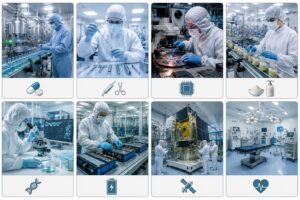
Cleanrooms are generally used for two main categories of applications: environments where viable particles (microorganisms) can harm a product or the human body, such as pharmaceutical, medical device, and cell therapy cleanrooms; and environments where non-viable particles can adversely affect product performance and service life, such as cleanrooms used in electronics, nuclear technology, and military industries.
The most important industrial applications of cleanrooms include:
- Pharmaceutical Industry: Manufacturing drugs, vaccines, and biological products, where even a single particle or microorganism can compromise an entire production batch.
- Medical Devices: Manufacturing syringes, implants, contact lenses, and surgical instruments, where microbial contamination must be minimized.
- Electronics and Semiconductor Industries: Manufacturing chips and electronic boards at microscopic scales, where even the smallest dust particle can cause functional defects.
- Food and Cosmetics Industries: Packaging supplements, food powders, and sensitive skincare products.
- Biotechnology: Stem cell and gene therapy research, which requires controlled environments to prevent biological contamination.
- Lithium Battery Manufacturing: Producing advanced batteries, where moisture and particles can compromise safety and performance.
- Aerospace Industry: Assembling satellites and space probes in cleanrooms to prevent terrestrial microorganisms from being transferred into space.
Cleanroom Construction Costs and Factors Affecting Them
The cost of designing and constructing a cleanroom is not a fixed amount and depends on several factors, including:
- The size of the space and the required cleanroom classification (the higher the cleanliness level, the higher the cost)
- The type of ventilation and filtration system (HEPA versus ULPA)
- The materials used for walls, floors, and ceilings
- Control equipment and the level of intelligence and automation in the monitoring system
- The project location and the environmental conditions of the construction site
Specialized companies in this field typically provide an initial design and detailed cost estimate after inspecting the project site. Since even the smallest design error can reduce the return on the overall investment, consulting with a specialized team before starting the project is highly important.
Emerging Applications and the Future of Cleanrooms
The world of technology is continuously becoming smaller and more sensitive, and in parallel, the demand for cleaner environments is increasing. Today, industries such as nanotechnology, advanced battery manufacturing, and biotechnology have expanded cleanroom applications beyond traditional pharmaceuticals and electronics.
The future of cleanrooms is moving toward greater intelligence, sustainability, and automation. Online particle monitoring systems (PMS) that continuously monitor environmental data in real time, robots designed to reduce human presence in critical areas, and artificial intelligence algorithms that optimize HVAC energy consumption are all shaping the outlook for future cleanrooms.
Frequently Asked Questions About Cleanrooms
1. What is a cleanroom? A cleanroom is a controlled environment in which airborne particles, chemical and microbial contaminants, temperature, humidity, and air pressure are managed to prevent contamination of sensitive industrial and medical processes.
2. How are cleanrooms classified? According to ISO 14644-1, cleanrooms are classified based on the maximum allowable number of particles per cubic meter of air, ranging from ISO Class 1 (the cleanest) to ISO Class 9.
3. What is the difference between HEPA and ULPA filters? HEPA filters capture at least 99.97% of particles measuring 0.3 microns, whereas ULPA filters, with higher efficiency, capture 99.999% of particles measuring 0.12 microns and are used for more sensitive environments such as semiconductor manufacturing.
4. What is the difference between laminar and turbulent airflow? Laminar airflow provides uniform, unidirectional air movement for higher cleanroom classifications, whereas turbulent airflow is used for lower classifications by diluting contaminants and at a lower cost.
5. What factors determine cleanroom construction costs? The size of the cleanroom, required classification, ventilation and filtration system, construction materials, and level of intelligence and automation in control equipment are the main factors determining cost.
6. Why are gowning and behavioral regulations important in a cleanroom? Because humans are the largest source of particle contamination in a cleanroom. Failure to follow appropriate gowning and behavioral procedures can expose the entire production or research process to contamination.
Conclusion
A cleanroom is both a strategic tool and an engineering necessity for leading industries in the twenty-first century. Although it may appear simple at first glance, it is in fact a culmination of engineering precision in controlling the invisible world of particles and microorganisms. From life-saving pharmaceuticals to the processors that drive the digital world, countless advanced products depend on the controlled cleanliness of a cleanroom. A proper understanding of cleanroom definitions, standards, components, and design processes is a prerequisite for entering the world of advanced technologies and ensuring the highest possible levels of quality and safety. If you are planning to design or construct a cleanroom for your project, consult a specialized team before taking any action so that the appropriate classification, materials, and ventilation system can be selected according to your project’s actual requirements.


